This might come as a surprise, but sooner or later your call to some external API will get rate-limited.
It will probably happen sneakily. There will be a script that never had any problems fetching data from that API? Until, suddenly, errors start being logged. Usually lots of them. And then, a few minutes later, the flow of errors will stop and the data will flow again and the script will chug along as it did before, blissfully unaware that rate-limiting exists.
It’s kinda hard to write code for handling a Rate-limit. The first problem is that we often fail to even remember that most APIs do have a limit. At the very least the following 2 matters mess with us:
- We, personally, never experience being rate limited when testing the API. Because we, personally generally test APIs manually. We build 1 API call at a time and then we attentively check the response before doing another API call. Thus, we might be averaging at less than 50 calls per hour…waaaaay below most rate limits.
- The code can’t be tested. Even if we do build some rate-limit-handling code, this code just sits in production… for months, waiting for its opportunity. Does code that was never run really work? Technically, we could manufacture the rate-limit and test the code, we could just write a script that frantically calls the external API until we receive a ‘429 Enough!’. But, how often do we go to such lengths?
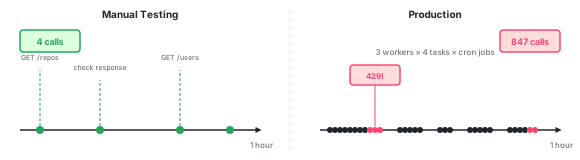
And so it happens that the rate-limit response is usually handled in one of 2 ways:
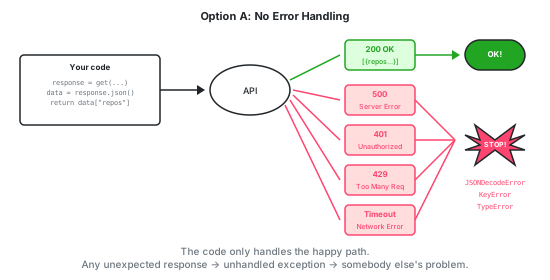
- option A): Oops, totally forgot to handle any errors at all
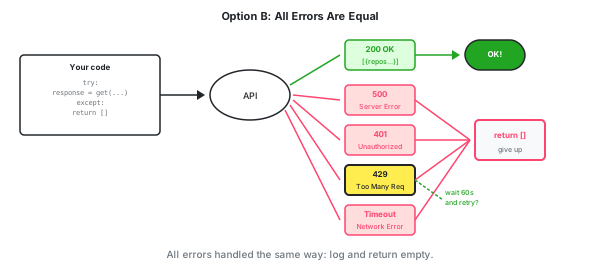
- option B): All errors are equal, all errors are bad, code stop
In this post
Option A) Oops, totally forgot to handle any errors at all
This is the easy-way-out.
It is also called the “happy path” or the “first iteration”, but those names were picked just to make us feel better about this code. “Yeah, I know this isn’t handling errors, but that’s just the first iteration, the proof of concept. Just wait a couple of weeks, we’ll fix this soon.”
Nevertheless, this is often production code.
from requests import Response
import requests

def fetch_all_user_repos() -> list[str]:
    """Oops, totally forgot to handle errors"""
    response: Response = requests.get("https://api.github.com/user/repos")
    response_data: list = response.json()
    all_repos = [repo["full_name"] for repo in response_data]
    return all_repos
We expect to receive:
[
  {
    "id": 1296269,
    "name": "Hello-World",
    "full_name": "octocat/Hello-World",
    "owner": { "login": "octocat", ...},
    ...
  },
  {
    "id": 1296459,
    "name": "Good-Morning-World",
    "full_name": "octocat/Good-Morning-World",
    "owner": { "login": "octocat", ...},
    ...
  }
]
If we get anything else, then… we transfer any responsibilities to other code, to the calling code.
Because, our puny function doesn’t have enough context to know what to do. Surely, the caller will have all the context and will handle all the errors. We must stay transparent, and the caller must just learn to handle every possible exception from every possible sub-call.
Of course this makes no sense. The caller shouldn’t have to know that this function even makes API calls. Some reasonable levels of layering have to exist, each layer should take care of its own errors.
Option B): All errors are equal, all errors are bad, code stop
When we have a bit more time, and we do consider errors, we often treat all errors equally: all errors are unrecoverable, a “500 Internal Server Error” response is the same as a “401 Unauthorized” response and the same as a “429 Too Many Requests” response.
import logging
from requests import Response
import requests

logger = logging.getLogger(__name__)

def fetch_all_user_repos() -> list[str]:
    """All errors are equal, all errors are bad, code stop"""
    # Handle RequestException
    try:
        response: Response = requests.get("https://api.github.com/user/repos")
    except requests.RequestException as exc:
        logger.warning(f"We received broken data when fetching repos for ...", exc_info=exc)
        return []

    # Handle non-200 response
    if response.status_code != 200:
        logger.warning(f"We received non-200 response fetching repos for ...")
        return []

    # Handle non-JSON response
    try:
        response_data: list = response.json()
    except ValueError as exc:
        logger.warning(f"We received broken data when fetching repos for ...", exc_info=exc)
        return []

    # Finally return repo names
    all_repos = [repo["full_name"] for repo in response_data if "full_name" in repo]
    return all_repos
This time, we don’t let the RequestException bubble up to the caller, because we realize we do have more context for handling HTTP related problems than some code way up the chain that is just trying to populate a dropdown with a list of all options.
But not all errors are made equal
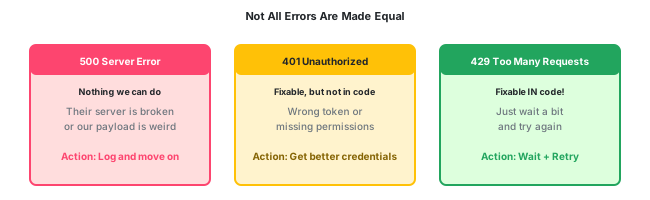
- A 500 response often means there is nothing we can do about it. Sometimes it can also mean our payload is invalid in a way that the developers in that other company didn’t anticipate.
- A 401 Unauthorized response means that we can absolutely fix the problem, but it will happen outside of code. We have to get the right token/permissions from somewhere.
- A 429 Too Many Requests response also means we can fix the problem, and we should fix it in code. We should wait a bit and then send the API call again.
What is a 429-Too Many Requests response made up of?
In theory, when an API wants to communicate that you are sending it too many requests too quickly, it should send you:
- the HTTP status code 429 and
- the HTTP header
Retry-Afterwith information (number of seconds or HTTP date) about how long we have to wait until we make another request.
The idea is that the caller will respect Retry-After and diligently wait before making further API calls, because they have nothing to gain from not respecting it. Surely, they aren’t trying to DDoS the external API, right?!
HTTP/1.1 429 Too Many Requests
Content-Type: text/html
Retry-After: 120

<html lang="en-US">
  <head>
    <title>Too Many Requests</title>
  </head>
  <body>
    <h1>Too Many Requests</h1>
  </body>
</html>
In practice, both the API owners and the API callers are disobeying the rules.
The API owners seem to dislike the Retry-After header and instead love to invent their own, custom names for headers. Because why follow the established standard, when we can just invent our own X-Rate-Limit-Remaining-Seconds-header or X-RateLimit-Reset and send the number of seconds in these headers. One has to be free to express oneself.
The API callers, however, mostly ignore this header, no matter what it is called.
It turns out, we do have something to gain, by not waiting. “To wait” needs to be written into code, whereas “just call again” can be as simple as one for-loop or one function call. Particularly in modern systems, where, at any given time, we can have several tasks that are running in the background calling the same API and several users who are also simultaneously asking for the same API responses. It is hard work to coordinate them all to wait for 30s until the 429-window passes. It is really, really much easier to just let all code call whatever it wants and turn every 429-response into return [] or return None or whatever is used for empty-response.
We can only expect developers to wait for Retry-After-number-of-seconds if we can find
- a simple! way to talk to all processes making API calls at once, so all workers, all tasks, and
- a simple! way to express that they need to wait. It is not enough that we can easily detect 429-response in one place, we also need a simple way to communicate the “don’t-call-again”-behavior.
Step 1: How to speak to all tasks/workers from 1 place?
If only we had a central location that all API calls travel through, then we could easily prevent further calls to a rate-limited-API for Retry-After-number-of-seconds. Do we have such a place?
Often yes. In the form of the Python requests-library.
In the requests library there is a concept of “transport adapters”, these serve as a sort of middleware for every HTTP request. In these adapters you can express rules such as our “when you receive a 429 response do …
The HTTPAdapter-s are meant to define rules for interacting with a specific external API, that is why the adapters are always “mounted” on a specific url-prefix. But we will mount/register our custom adapter to all urls by choosing the prefix="https://" and prefix="http://".
import requests
from requests.adapters import HTTPAdapter
from requests.models import Response

# ↓ Our custom adapter. It extends requests.HTTPAdapter.
# For now, it does nothing.
class RateLimitAdapter(HTTPAdapter):
    def send(self, **kwargs) -> Response:
        response: Response = super().send(**kwargs)
        return response

def new_session():
    session = requests.Session()

    # TODO: here comes other common HTTP code
    #  like setting headers or retry strategy or ...

    # ↓ Here our adapter is "mounted" onto the session object.
    # We mounted it onto 2 partial urls: http and https, because the idea
    # behind adapters is that they define the rules of interaction for
    # one, specific, external API. But by saying "http://" we are tying these
    # rules to the whole traffic (except ftp:// and such of course).
    adapter = RateLimitAdapter()
    session.mount("https://", adapter)
    session.mount("http://", adapter)
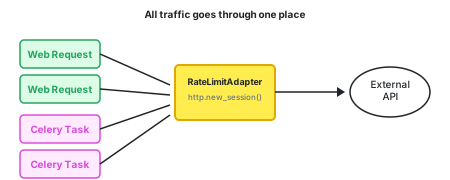
Best next steps are:
- put the above code into the
http.pyfile orhttpfolder and - call it with
http.new_session().get("http://api....")orhttp.new_session().post("http://api...", json={}) - make sure we always go via
http.new_sessioninstead of callingrequests.get/.post/...directly.
With this we have solved the first hurdle: how to speak to ALL calling code from 1 place. Now on to: how do we tell them all to wait?
Step 2: How to communicate “wait for 30s”?
What can we possibly put into RateLimitAdapter that carries the message “you have to wait for 30s”?
A custom exception class could do this. But then we also have to catch this exception everywhere, which defeats the purpose of finding this central location. ❌
Also, our goal is to not do API calls for 30s, so we have to act before the API call goes out, so before we call super().send(**kwargs).
We need an if-statement like this:
class RateLimitAdapter(HTTPAdapter):
    def send(self, request: PreparedRequest, **kwargs) -> Response:

        # 🡻
        if we_are_in_429_window(request):
            return something
        # 🢁

        response: Response = super().send(request, **kwargs)
        return response
The we_are_in_429_window could access some sort of global state, where we can store data about the 429-window, which would be:
- the API endpoint, example:
http:://api.github.comfor GitHub’s REST API - the duration, example: 30s
- the token/authorization data this applies to, because not all of our tokens, not all of our customers have reached their API rate-limit, just 1 token has, everybody else can keep calling GitHub’s API as much as they want to
Now, we could build a complex, precise system to handle this or … we could build a simple, quick, alternative solution: we store 429-responses in a Redis cache for the duration of the 429-window under a token-defined key.
💡 Solution: Let’s cache the 429-response in Redis for the duration of the requested wait-period.
Redis flow
The flow would go like this:
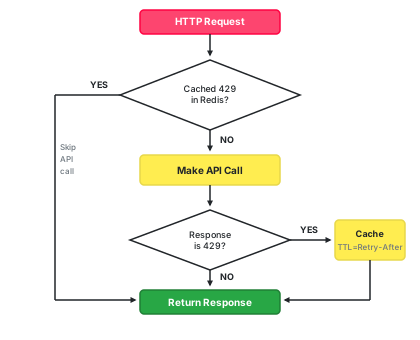
In summary:
- before we make any API calls, check Redis
- after we make API calls, store the
Responseobject in Redis if it is a 429-response withTTL=<Retry-After> seconds
This would work precisely because the TTL for the Redis Response object is precisely the “30 seconds window”, precisely the number of seconds that we have to wait until we stop being rate-limited.
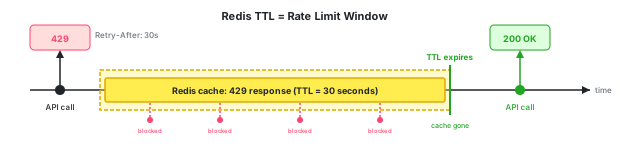
This solution also means that we don’t have to change any other code (if we don’t want to). The code that triggers the API calls, that calls new_session().request("get", "http:...") needs no change. It will receive the very same response it would receive if we DID call the remote API.
Yes, ideally, all calling code would also handle rate limit responses, but that is not a separate problem.
What we’ve achieved with this Redis-cache is that “if the API says wait 60 seconds, we actually wait 60 seconds”. And we did this with the minimal amount of code.
We glossed over the Redis key
Now, to iron out the details. The most delicate detail of this plan is how to define the Redis key.
The Redis key must be unique for every token/authorization data. But this means that when we are building the key, we must know where every API stores their authorization data to be able to extract it.
In my mind this is annoying. This generic HTTP adapter class must now understand that there is a GitHub API and a Linear API and a Jira API and Circle API and … and how each of these authorize their API users, which is … silly. The HTTP adapters should be API agnostic. And when in 3 months another developer introduces a new external API, let’s say PagerDuty’s API, how will she know that she needs to modify our RateLimitAdapter class? It’s not ideal, but, in this case, my stance is: “such is life”. This problem can be solved, code can be built to handle these connection, but I, for one, decided it isn’t worth building a solution for this in our system. Your system might be different.
How I build the Redis key
I decided that extracting API authorizations will be an ongoing task.
My code will look at all the places, where I know the authorization data can be. If I find no authorization data, then I refuse to store anything to Redis and I log an error to nudge developers to research.
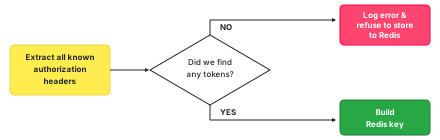
The key combines org ID (because I am working in a multi-tenant system), the API host, and a hashed auth token:
key = f"http.rate_limits.{org_id}.{url.host}.{hashed_auth_token}"
Full implementation: extracting and hashing auth tokens
import hashlib
import logging
from urllib3.util import parse_url
from urllib3.util import Url
from requests.adapters import HTTPAdapter
from requests.models import PreparedRequest
from requests.models import Response

logger = logging.getLogger(__name__)

class RateLimitAdapter(HTTPAdapter):
    ...
    def _get_auth_tokens_from_request(self, request: PreparedRequest) -> str | None:
        headers = request.headers

        # Standard location for auth tokens
        auth_header = headers.get("Authorization")

        dd_tokens = str(headers.get("DD-API-KEY", "")) + str(headers.get("DD-APPLICATION-KEY", ""))  # Datadog
        sf_token = headers.get("X-SF-Token")  # SignalFX
        gl_token = headers.get("PRIVATE-TOKEN")  # GitLab
        cc_token = headers.get("Circle-Token")  # CircleCI
        # .... more tokens

        all_tokens = (auth_header, dd_tokens, sf_token, gl_token, cc_token)
        if not any(all_tokens):
            return None

        # hash the access tokens, because we don't want to have customer's tokens plainly visible in Redis
        hashed_tokens = hashlib.sha256(f"various header tokens: {all_tokens}".encode()).hexdigest()
        return hashed_tokens

    def _get_redis_key(self, request: PreparedRequest) -> str | None:
        org_id = ... # get the tenant ID as you do
        url: Url = parse_url(request.url)

        hashed_auth_token: str | None = self._get_auth_tokens_from_request(request)
        if not hashed_auth_token:
            # The nudge to developers. The correct location for this would be when we actually
            # get a 429 response, so we only log the error when we know that an authorization header
            # must be present. Presumably no API will rate limit non-authenticated users.
            logger.log(
                logging.WARNING, # or logging.ERROR
                "Could not extract authorization info to build a Redis key "
                "for storing 429 response. "
                "We probably need to amend RateLimitAdapter._get_auth_tokens_from_request "
                "and add a new way to extract the authorization info.",
                extra={"url": url, ...}
            )

        key = f"http.rate_limits.{org_id}.{url.host}.{hashed_auth_token}"
        return key
Safeguard: Why not take all HTTP headers?
I could have just packaged up all the HTTP headers, but what if some API call sends no tokens at all or doesn’t send them in HTTP headers? In this case it is better to not cache and call the API endpoints incessantly than to cache the wrong response.
Safeguard: Include tenant information
Since my code lives in a multi-tenant project, I preemptively also included the Org information into the key. Just to shrink the scope of damage in case my code has a bug.
Safeguard: Hash the tokens
We don’t want the API tokens to just sit in Redis in their correct form. So, we do quickly hash them with hashlib.sha256().
What about the TTL?
To get the TTL, we have a similar problem as with defining the Redis key, we again have to check all the different HTTP headers where this information could possibly be. The difference is that we can always use a default value, if we can’t find this header. With the authorization data, we could not default to any value.
The one safeguard I do recommend is: have a max value. Even if the API sends you Retry-After=<5h>, I would ignore this and keep the max TTL relatively low, at maybe max 1 hour or less of course.
retry_after: int = int(response.headers.get("Retry-After"))
retry_after_sec = min(retry_after, timedelta(minutes=60))
Full implementation: extracting sleep time from various headers
import logging
from requests.adapters import HTTPAdapter
from requests.models import Response
from datetime import timedelta

logger = logging.getLogger(__name__)


class RateLimitAdapter(HTTPAdapter):
    DEFAULT_429_SLEEP_SEC = 5
    MAX_RETRY_AFTER = timedelta(minutes=60).total_seconds()

    ...
    def _extract_sleep_time(self, response: Response) -> int | None:
        headers = response.headers
        retry_after: str | None = headers.get("Retry-After")
        if retry_after is None:
            retry_after = headers.get("X-Rate-Limit-Remaining-Seconds")
        if retry_after is None:
            .... # more way to extract the number of seconds we need to wait for

        if retry_after is None:
            logger.warning(
                "We can't find Retry-After information about "
                "how long we have to wait before the next request. "
                "We probably need to amend RateLimitAdapter._extract_sleep_time "
                "and add a new way to extract this info."
            )
            retry_after = self.DEFAULT_429_SLEEP_SEC

        retry_after_sec: int = self._str_to_int(retry_after, default=0)
        retry_after_sec = min(retry_after_sec, self.MAX_RETRY_AFTER)
        if retry_after_sec > 0:
            return retry_after_sec

        logger.warning(
            f"The {retry_after_sec=}, the value must be >0 ."
            "Will not save to Redis.",
            extra={...}
        )
How to store an HTTP response in Redis
We can’t store the requests.Response directly in Redis, we need to serialize it first.
At the time I chose to use marshmallow for the serialization and deserialization.
There is 1 important thing about the deserialization: we want to return a requests.Response object. Because that is what all the callers expect. We want the response from redis.get() to match the response from requests.send(), so that the calling code doesn’t have to make any adjustments to our change.
# Dump requests.Response into a dict via ResponseSchema
serialized_response = ResponseSchema().dumps(response)
# Store with TTL = retry_after seconds
redis.setex(key, retry_after_sec, serialized_response)

# Retrieve and deserialize back to requests.Response
# with custom DeserializedResponse class
response: Response = ResponseSchema().loads(redis.get(key))
Full implementation: serializing and deserializing HTTP responses
import logging
from marshmallow import Schema
from marshmallow import fields
from marshmallow import post_load
from requests.adapters import HTTPAdapter
from requests.models import Response
from requests.models import PreparedRequest

logger = logging.getLogger(__name__)


class DeserializedResponse(Response):
    def __repr__(self):
        return "<%s [%s]>" % (self.__class__.__name__, self.status_code)

class ResponseSchema(Schema):
    status_code = fields.Int()
    encoding = fields.Str()
    reason = fields.Str(allow_none=True)

    @post_load
    def make_response_obj(self, data, **kwargs) -> DeserializedResponse:
        response = DeserializedResponse()
        response._content = b""  # We don't care what the content was
        response.status_code = data["status_code"]
        response.encoding = data["encoding"]
        response.reason = data["reason"] or ""
        return response


class RateLimitAdapter(HTTPAdapter):
    ...
    def _store_response(self, response: Response, key: str, retry_after_sec: int) -> bool:
        # Before we write to Redis, we need to serialize
        try:
            serialized_response = ResponseSchema().dumps(response)
        except Exception:
            logger.exception(f"An error occurred while trying to serialize a response")
            return False

        success = redis.setex(key, retry_after_sec, serialized_response)
        if not success:
            logger.exception(
                f"Could not add serialized response to Redis, key={key}, retry_after_sec={retry_after_sec}"
            )
            return False
        return True

    def _deserialize_redis_response(self, key: str, request: PreparedRequest) -> Response:
        # We want to deserialize the redis data right back into a requests.Response obj
        response_data: bytes = redis.get(key)

        try:
            response: Response = ResponseSchema().loads(response_data)
        except Exception:
            logger.exception(
                f"Could not deserialize Response from Redis. Will make the request now and delete "
                f"this Redis key {key}."
            )
            redis.delete(key)
            return None

        # we want to pretend we make the API request, so we want to
        # return a requests.Response that looks just like what we would receive
        # in that case
        response.request = request
        response.url = request.url
        return response
Conclusion
The elegance of this solution is in its simplicity and in using Redis TTL as the rate-limit window itself. The cache disappears by itself as soon as the window passes. On top of that, we were able to contain the code changes to 1 place and every session.request() magically benefits.
This solution could be polished further if we needed it to be better. It can also be further simplified. It is very adjustable to the particularities of your system.
It is in our best interest to let the remote API be after they tell us to relax. Otherwise,
- we are wasting our own resources: CPU time, network traffic both ways, storing logs is expensive
- our app could get banned entirely: some APIs punish repeat offenders with IP blocks and revoked API keys
And here is this very simple solution that can solve this annoying problem.
Next chapter
⏭️ Pattern #2: Retrying Celery Tasks from Page 47