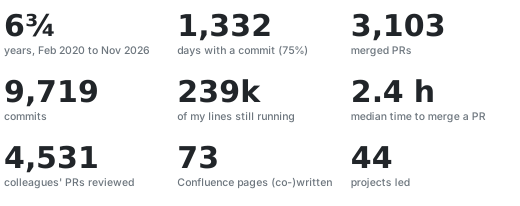
What do you do when you change tams??? I had a bit of free time, so of course I asked Claude to turn the last 6¾ years into charts.
It’s such a weird thing… to see what I’ve been up to for the last ~7 years, I’ve already forgotten about half of these projects, that seemed so very important at the time.
About 40 PRs a month, every month, for almost 7 years
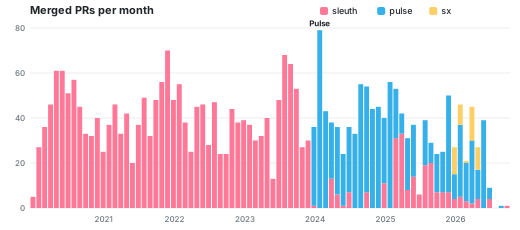
The peak, March 2024 with 79 PRs, came in the first weeks of building Pulse, right after the fork.
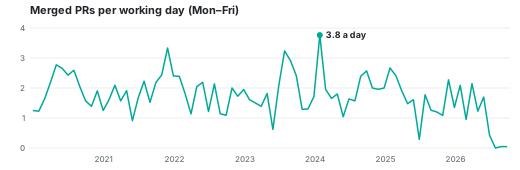
Months usually have about 21 working days, so.. 79 seems somewhat excessive.
Who was writing code with me
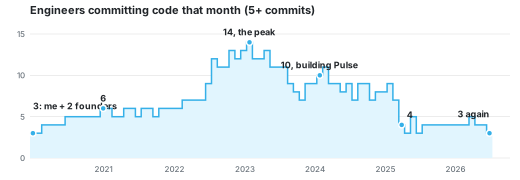
I counted only people, who had at least 5 commits that month. We started as 3, grew to 14, and ended as 3 again. Funny how that works.
463k lines of code written, 317k changed or removed
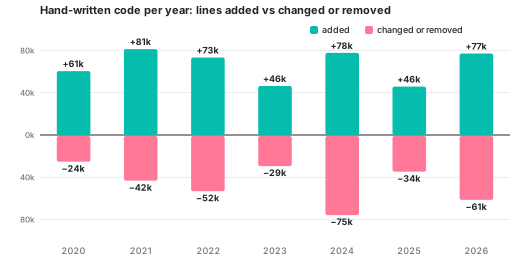
Hand-written code only (Python, Go, JS/TS), from my commits on the main branches. Generated files (GraphQL schema dumps, JSON test cassettes, lock files, migrations) are left out.
239k of my lines are still running today
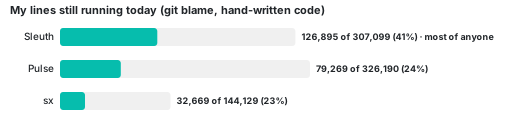
Generated code, test fixtures, mock data and migrations are left out of both my lines and the total.
In Sleuth, I’m the author of more surviving lines than anyone else.
The oldest line of real code of mine that is still running is from my second week, 4 March 2020:
return HttpResponse(status=401)
And the oldest whole class is BaseDevCommand from 10 March 2020, the base for our local dev commands.
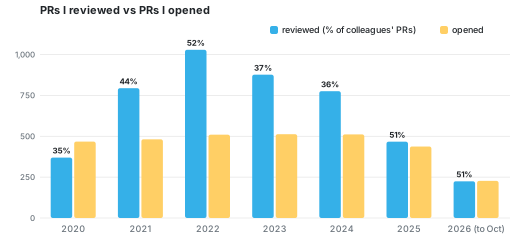
I reviewed 4,531 of my colleagues’ PRs, 42% of all of them
Median time until my first review: 26 minutes over all 6¾ years, and only 7 minutes in 2024.
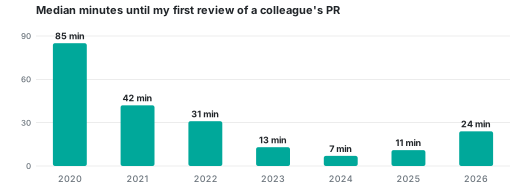
Counts include every team. Review speed counts only the EU team’s PRs (same rules as in Exhibit D), so the numbers differ slightly from that post.
16 tech specs, 13 proposals, 9 investigations: 73 Confluence pages in total
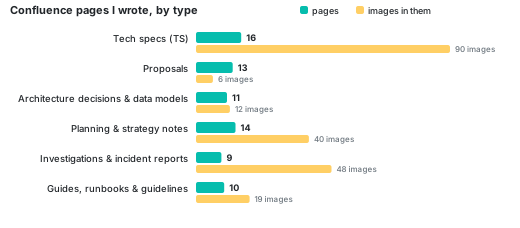
I found it fun to look at my avg number of pics on a page, because “an image is 1000 words”.
On top of the pages, I wrote 495 Confluence comments.
1,332 days with at least one commit
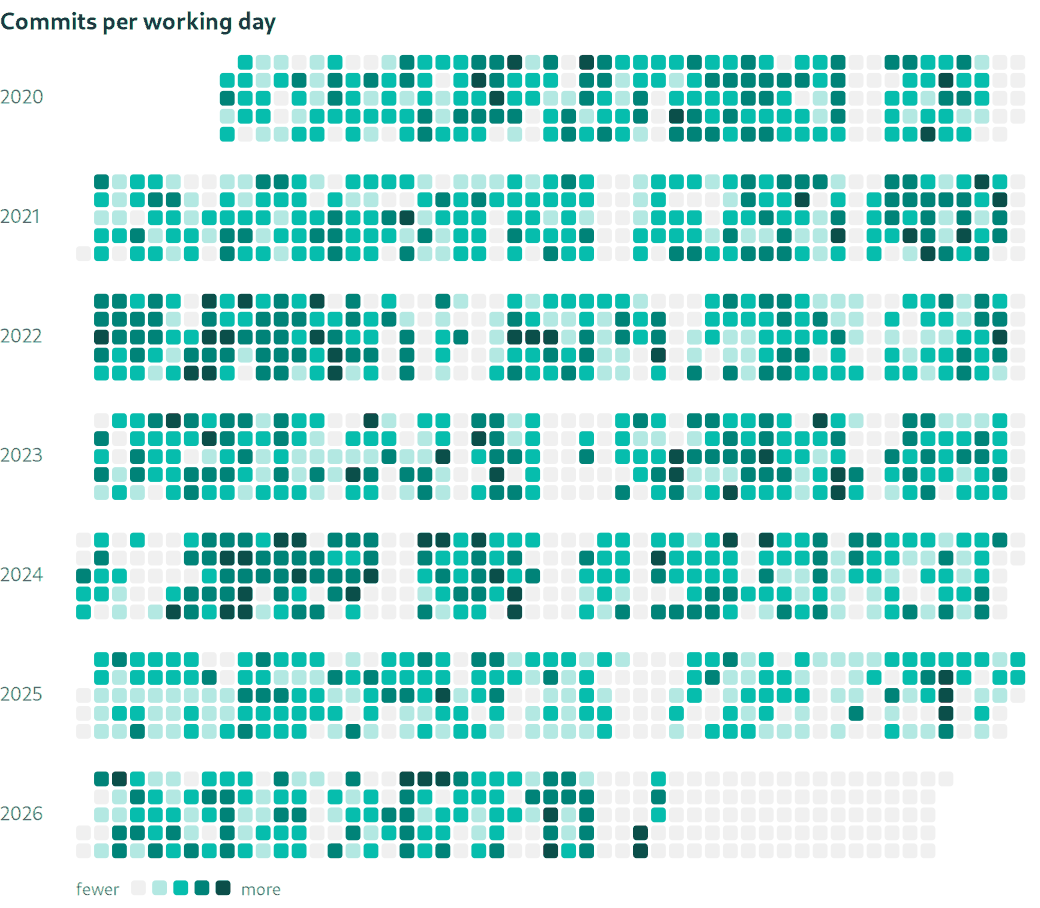
One square per working day. The darker the square, the more commits that day. The record is 62 commits in one day (7 August 2026).
Office hours: 97% of commits between 9:00 and 18:00
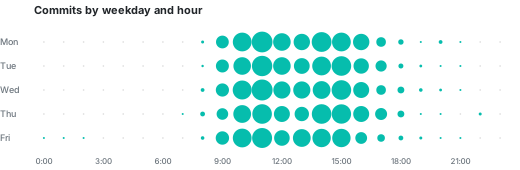
Most commits land around 11:00 and 15:00, with a lunch dip at 13:00.
The median PR changes 87 lines, the p99 PR changes 5,028
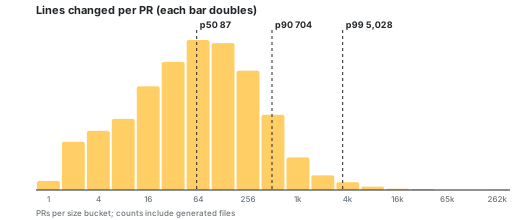
136 PRs changed 2 lines or fewer. The biggest deleted 266,439 lines. GitHub’s counts include generated files (schema dumps, test cassettes), so the big PRs look bigger than the actual code change.
Half my PRs merged within 2.4 hours
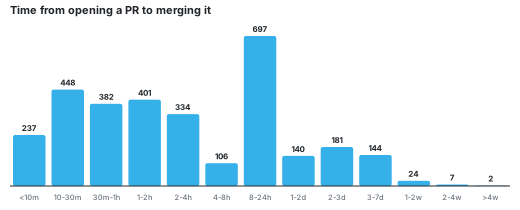
Time from opening a PR to merging it, so time spent as a draft counts too. 1,067 PRs merged within an hour, and 237 within 10 minutes. p90 is 67 hours, which is roughly a weekend: open on Friday, merge on Monday.
PRs got faster to merge, but not smaller
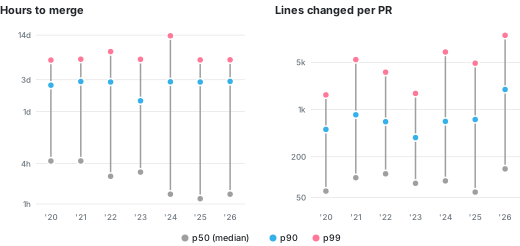
p50, p90 and p99 per year, on a log scale. The 2026 jump in PR size is partly generated Go code in sx.
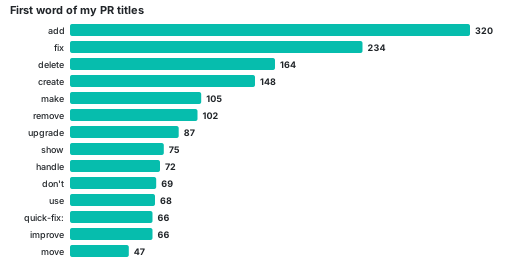
“Add” and “Fix” lead, then “Delete”
46,000 words and 983 images in PR descriptions
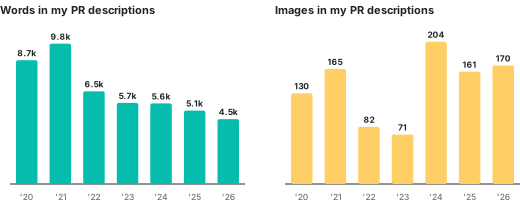
About half of my PRs have a real description. Together that’s about 46,000 words, not counting code blocks and links… and 983 images in 498 PRs. The record is 16 images in a single PR.
The longest descriptions have: 421 words, 414 words, and 398 words.
On the side: 41 blog posts and 11 conference talks
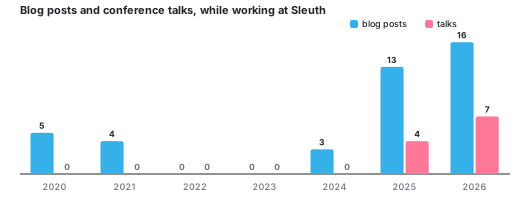
While working at Sleuth, I wrote 41 posts on this blog and gave 11 conference talks in 8 countries, all in 2025 and 2026. (Ok, technically 10: I was fully prepared for TDC in Trondheim, had taken vacation days, and then flight trouble kept me from getting there. I’m counting it anyway.)
The forget-me-nots
This is to remember what I worked on, because as I move on, new projects overwrite my memory space.
Sleuth: deploy tracking
DORA metrics
Health, teams, integrations
Background jobs and cleanups
Pulse
Pulse and Sleuth
AI tools
Awards
- Most reverted: gevent workers. Merged and reverted 4 times in 3 weeks (Nov to Dec 2020) before it stuck.
- Best branch name:
graphene-v3-again-again. Merged, reverted, relanded as “Graphene V3 Still”. - Biggest delete: −266,439 lines. “Delete all in-active apps”, 1,971 files.
- Most ironic title: “Simple things to make the other PR smaller”. The biggest addition of all: +62,121 lines. Pulse, 2024.
- Slowest merge: 118 days. Also called “Delete all in-active apps”, the first of two PRs with that title. Pulse, 2024.
- Fastest merge: 14 seconds. A revert, of course: Revert “Exclude ignored PRs”. 2023.
- Busiest day: 62 commits, 7 August 2026.
- Most PRs merged in one day: 10 PRs, 24 January 2022.
- Most honest: “Speed up MTTR + ES fix, probably”. 2022.
- Most self-aware: “Show insights in email (in an ugly way)”. 2021.
- Most careful: “Improve migration: make it waaaaaaay slower”. 2022.
- Most philosophical: “Less than 24h is still 1 day”. 2024.
- Most exciting punctuation: “Change [!] to [!]!”. 2026.
- First sign of things to come: “Temp. skip the most flaky test”. My first months, 2020.
Well, this was a silly way to spend 4h… hunting down data, double checking it. Weren’t LLMs supposed to make us faster?
But it is also a fun thing to have, a measuring stick, if you will, for my future jobs. I now also wish I still had data from some previous jobs, to have something to compare these stats to.. oh well.